Fewer Fills, Less Wastewater
Conventional cleaning fills a system, circulates, dumps and fills again — often seven or eight volumes of water to reach the cleanliness the specification actually asks for. Most of that water is only carrying suspended solids that a filter would have taken out.
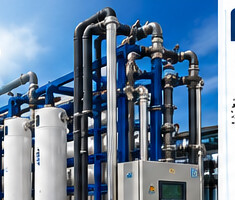
Volantis Group fits multi-stage mechanical filtration to the cleaning loop and recovers the medium instead of discharging it, which cuts water consumption, chemical spend and wastewater volume on the same scope. Recovery rates run 70–90% depending on the system and the contamination load.
Filtration Stages
Progressive mechanical filtration from 100 microns down to 0.45, staged so the coarse fraction is taken out first and the fine cartridges are not blinded doing the job of a strainer. Where ultra-low conductivity is required, mixed-bed polishing is added after the mechanical stages, with activated carbon, anion and cation exchange available as required.
What Is Monitored
- Turbidity (NTU) Suspended solids carried in the circulating medium.
- Conductivity (µS/cm) Dissolved ionic load, and the indicator for rinse completion.
- pH Chemistry control through the clean, rinse and passivation stages.
- Chlorides (Cl⁻) Critical where austenitic stainless is in the circuit.
- Temperature and differential pressure Filter loading, so cartridges are changed on condition rather than on schedule.
- Alkalinity (mg/L as CaCO₃) Residual chemistry carried into the next stage.
Filtration and water recovery are applied within VGI's pipe flushing and debris removal scope.
Back to Solutions